Monetization Design
Motley Credit Trial
The whole product, until your credits run out.
Motley's free tier hid the agent that sells it. The credit trial gives every family the whole product, Pro included, until 100 credits run out — about a dollar of what the work costs — then asks them to keep going, and everything they saved stays theirs.
Product Design · Pricing & Packaging · UX Writing

The best of Motley sat behind the paywall, and nothing capped what a free account could cost.
Pro was $9 a month against a Free tier and a ten-line feature split. Free families judged Motley by the parts that cost nothing, while the agent that researches schools for them, the part that converts, waited behind the paywall. Meanwhile free chat ran 60 messages an hour, indefinitely.
- 1.One rule in place of the split
- 2.A credit sized from what each action costs
- 3.A meter families can read without doing math
- 4.The ending: what stops at zero, and what stays
- 5.The rollout: when to turn it on
Give every family the best of Motley, and cap what any of them can cost.
Then show them the cap without making them ration the feature that would convert them.
What Motley is
Find the right school, and the neighborhood around it.
Motley is my product for New York families choosing schools and neighborhoods together. These are the three loops from its landing page.
Find the right school.
2,900+ public, charter and private schools, with state test results and the city's school survey where they exist.
Know how to get in.
Guides and tips for every NYC admissions step, from 3-K applications to the SHSAT, in plain English.
Pick the neighborhood.
All 197 residential neighborhoods, ranked by what matters to your family.
The decision
Everything, until your credits run out.
A ten-line comparison asks a family to weigh features they have never used. I wanted the free experience to be the whole product, with a ceiling on what it could cost, and the Pro families already pay for once they buy.
Every other choice followed from one question: what stops when the credits run out?
Weighed
Stop only what spends credits
The tracker, the application lists and the calendar would be free for good.
Weighed
Fall back to the old Free tier
Free chat would stay unmetered and uncapped, the problem I started with.
Chosen
Pause everything paid until they buy
One rule, the same one a cancelled subscriber already lives by.
So the rule is one sentence. Families use the agent before they are asked to pay, and the ask lands right after they have gotten the most out of it. The heaviest users, who cost the most, are the ones who reach it; light users cost little.
Before
Free, or Pro at $9 a month
A ten-line feature split, decided before the family had seen any of it.
After
A free trial of everything
The whole product until 100 credits run out, then Pro to keep going.
Everything in the trial runs on one unit, so the unit had to make sense to a parent.
Day one
A credit is a penny, not a token.
The trial starts the day a family signs in, with 100 credits: about a dollar of what the work costs Motley, which is the ceiling I was after.
One credit is 1¢ of that cost, about one Motley Intelligence message. Counting tokens would have been easier and meant nothing: tokens mean nothing to a parent, and about 95% of a message's tokens are Motley's own instructions and history, re-sent on every step. So the meter counts what the work costs and shows it as credits.
| Action | Credits |
|---|---|
| A Motley Intelligence message | about 1 |
| Analyze for My Family | about 1 |
| A PDF neighborhood report | 3–5 |
| Get next steps, with research | 4–20 |
I sized it from what each action really costs on production, where a message averages 0.93 credits. 100 credits is about 90 messages, or setup plus a few researched next steps and a report.
Credits count going forward only
An existing account starts with the full budget at its first visit. Nothing it did before is charged.
Credits move only when the family asks
Work Motley does in the background, monitoring schools and researching saved places, stays part of paid Pro.
From there, a family should always know where they stand, without being made to watch.
Every answer
A quiet meter.
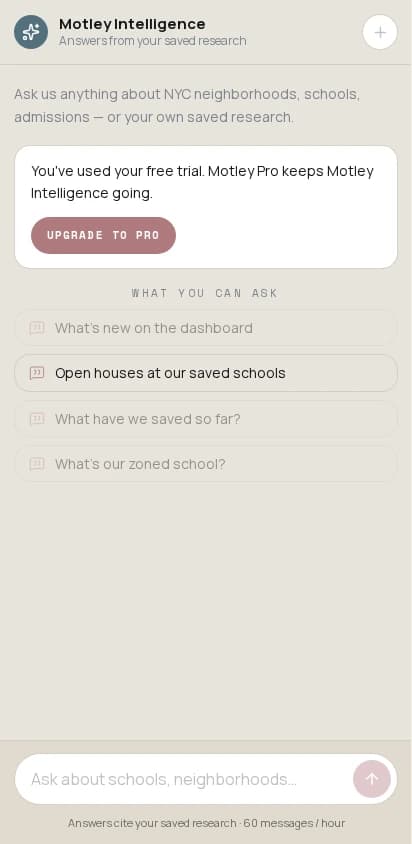
The risk I wrote down first was meter anxiety: a loud countdown makes families ration the feature that converts them. So the meter lives in three places, none of them a banner: a card in Settings, a footnote under the chat that ticks down after each answer, and a line in the user menu.
I built an itemized “where your credits went” list, then cut it. Nobody needs an invoice inside the product. One line of fine print says what uses credits and what doesn't.
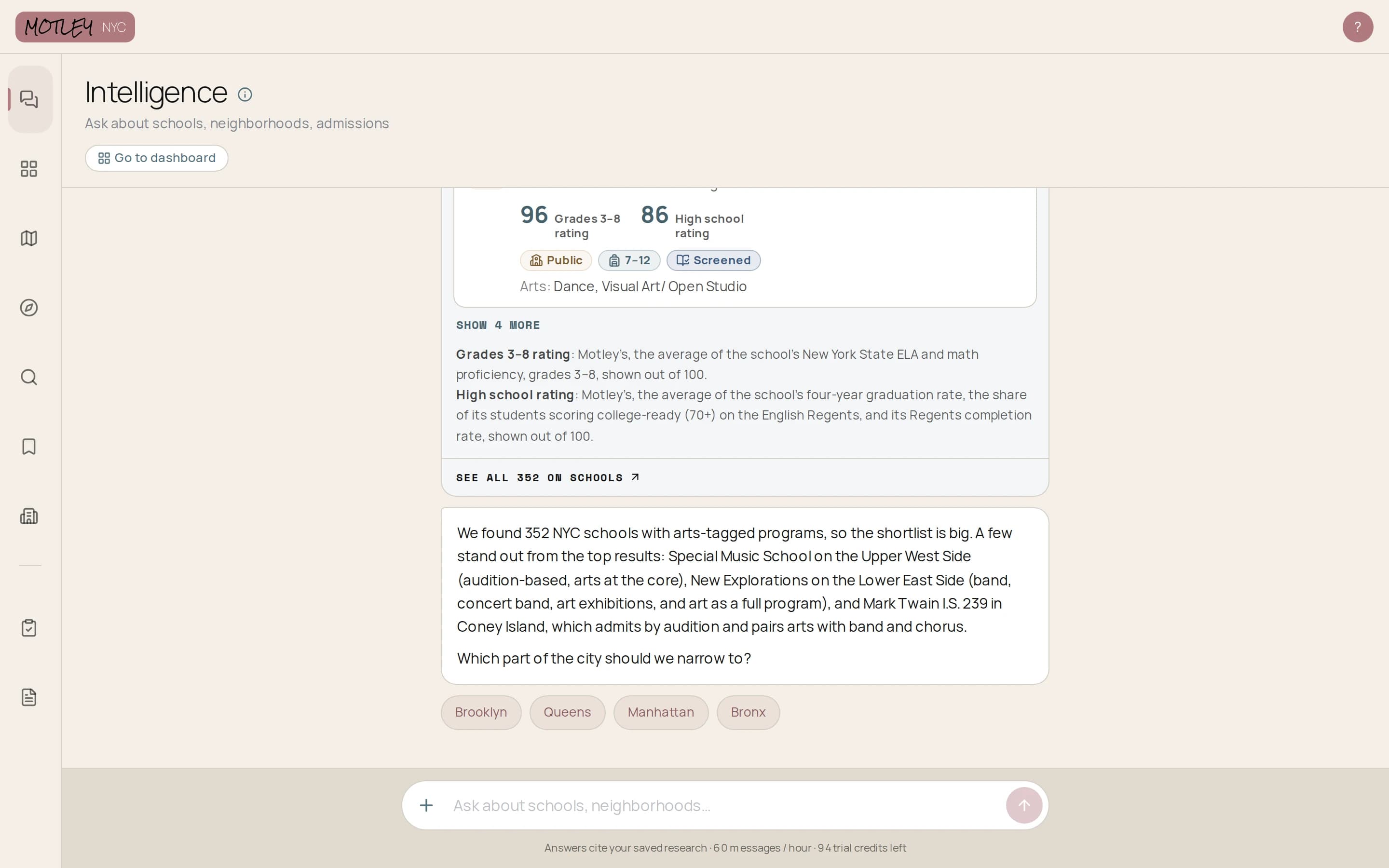
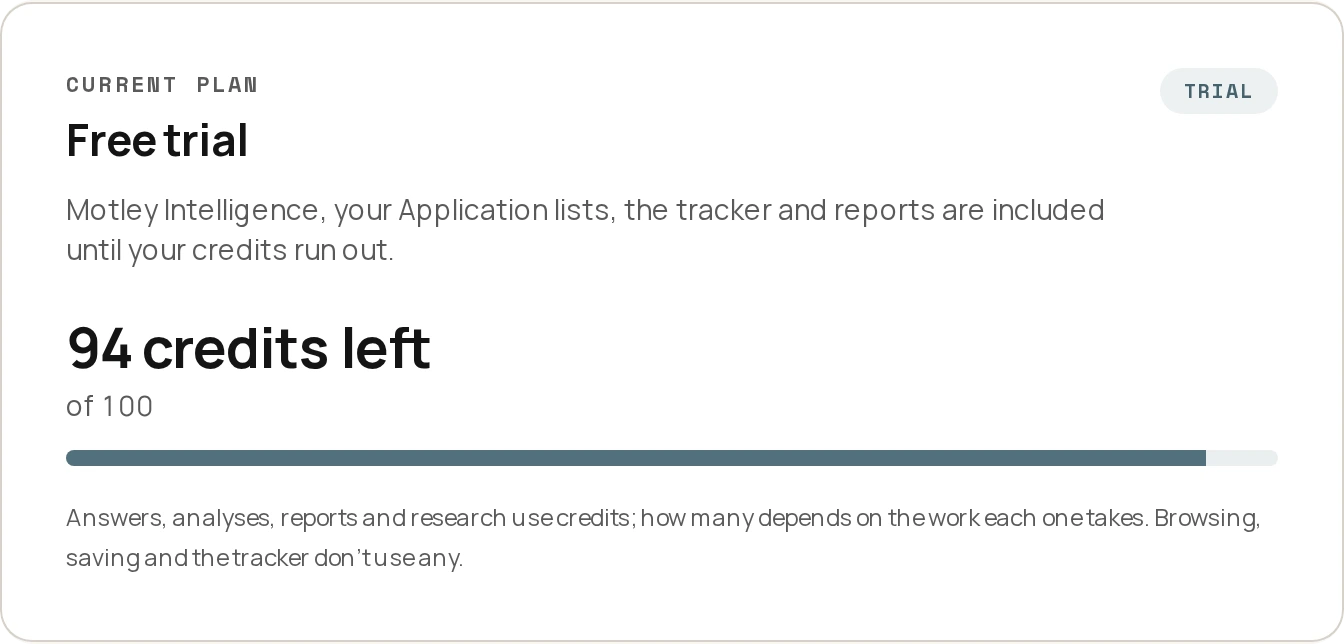
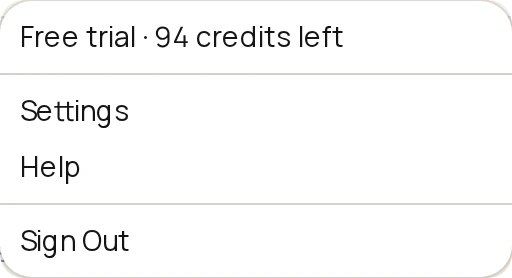
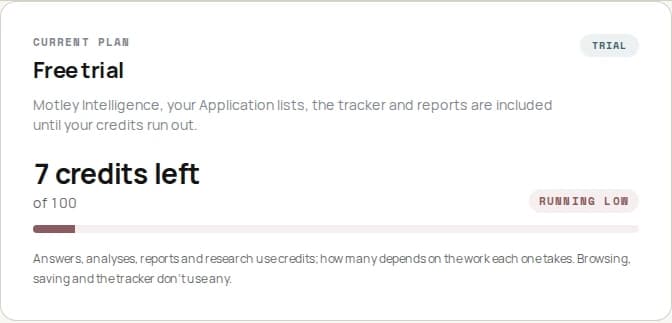
The meter is drawn in Motley's data color. Rose, the color of action, appears only on the upgrade button, so the meter never looks like a sales pitch until it is one.
The copy states facts. Public copy promises no message count, and Pro features are “included in your free trial”, never “free”.
Then the credits run out, and the trial has to end without feeling like a punishment.
Zero
Everything you saved stays yours.
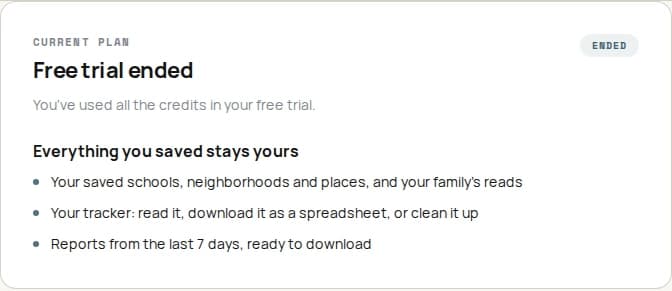
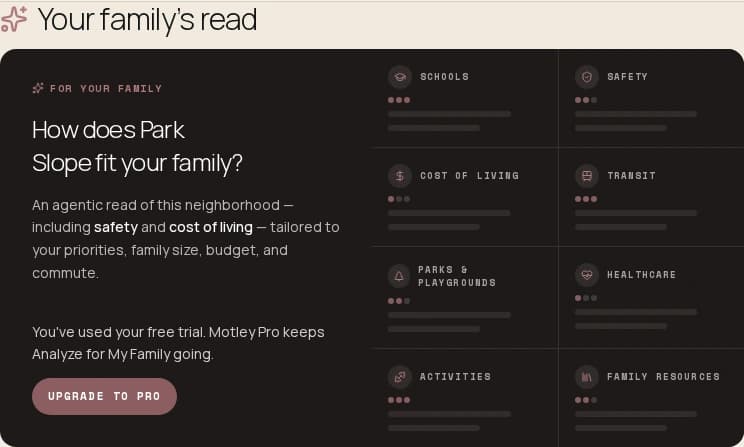
At zero, every paid feature pauses until the family buys Pro, exactly as it would for a subscriber who cancelled: their data kept, new writes locked. Nothing is cut off mid-sentence. The answer that crosses zero is delivered in full, and only then does the chat stop.
The pitch, while it runs
Everything in your trial, with no meter.
The pitch, once it ends
Pick up where your trial left off.
The last decision was when to turn it on.
December
No new paywall mid-deadline.
Motley's families are in the middle of applying to schools. Middle and high school applications close December 4 and December 11, and a family finishing an application that week should not meet a paywall that wasn't there the week before. So the trial is built and walked end to end in development, and it ships dark behind one switch: my account first, then a handful of real ones, then everyone after the 11th. Unsetting the switch returns every account to the old Free and Pro at once.
Outcomes
What it changes.
One rule beats a feature split
A family can't weigh ten features they've never used. They can understand “everything, until it runs out.”
Meter what it costs, show what it means
Counting priced cost keeps the ceiling honest. Showing credits keeps it readable.
The ending is part of the trial
Keeping everything the family saved is what makes “pick up where your trial left off” true.